
Three “Colorful” Moons Follow Blood Moon
After March’s Blood Moon, three more “colorful” Full Moons arrive in 2026. Learn why the Pink, Blue, and Strawberry Moons don’t actually change color.
Search for a city's moon distances:
Minumum (perigee) and maximum (apogee) distances from the Moon to the Earth.
The Moon Distance Calculator calculates the approximate minumum and maximum distances from the Moon to the Earth.
The Moon's distance to Earth varies. The two extreme points of the Moon’s orbit each month are known as the lunar perigee and apogee. The table below shows the time of lunar perigee and apogee.
| Date | Local Time | Distance in km | Distance in miles |
|---|---|---|---|
| Jan 1 | 4:44 pm | 360,349 km | 223,910 mi |
| Jan 29 | 4:45 pm | 365,871 km | 227,342 mi |
| Feb 24 | 6:03 pm | 370,133 km | 229,990 mi |
| Mar 22 | 7:43 am | 366,859 km | 227,956 mi |
| Apr 19 | 2:54 am | 361,633 km | 224,708 mi |
| May 17 | 9:47 am | 358,077 km | 222,499 mi |
| Jun 14 | 7:20 pm | 357,198 km | 221,952 mi |
| Jul 13 | 3:54 am | 359,114 km | 223,143 mi |
| Aug 10 | 7:13 am | 363,286 km | 225,735 mi |
| Sep 6 | 4:42 pm | 368,259 km | 228,826 mi |
| Oct 1 | 4:57 pm | 369,335 km | 229,494 mi |
| Oct 28 | 2:08 pm | 364,408 km | 226,433 mi |
| Nov 25 | 4:02 pm | 359,348 km | 223,288 mi |
| Dec 24 | 3:29 am | 356,652 km | 221,613 mi |
| * Distances are approximate. Closest Approach (Perigee) is highlighted. | |||
| Date | Local Time | Distance in km | Distance in miles |
|---|---|---|---|
| Jan 13 | 3:47 pm | 405,438 km | 251,928 mi |
| Feb 10 | 11:51 am | 404,576 km | 251,392 mi |
| Mar 10 | 9:43 am | 404,384 km | 251,273 mi |
| Apr 7 | 4:30 am | 404,970 km | 251,637 mi |
| May 4 | 6:30 pm | 405,839 km | 252,177 mi |
| Jun 1 | 12:33 am | 406,366 km | 252,504 mi |
| Jun 28 | 3:09 am | 406,265 km | 252,441 mi |
| Jul 25 | 12:45 pm | 405,548 km | 251,996 mi |
| Aug 22 | 4:21 am | 404,642 km | 251,433 mi |
| Sep 18 | 11:00 pm | 404,221 km | 251,171 mi |
| Oct 16 | 6:55 pm | 404,643 km | 251,433 mi |
| Nov 13 | 12:49 pm | 405,619 km | 252,040 mi |
| Dec 11 | 1:45 am | 406,420 km | 252,537 mi |
| * Distances are approximate. Furthest Apart (Apogee) is highlighted. | |||
After March’s Blood Moon, three more “colorful” Full Moons arrive in 2026. Learn why the Pink, Blue, and Strawberry Moons don’t actually change color.
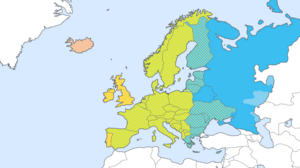
Daylight Saving Time (DST) begins across Europe early Sunday, March 29, 2026. Spain has promised a new push to end clock changes in the European Union.

Discover the phases of the Moon in March 2026. Also: How to see the total lunar eclipse on March 3, and why Artemis II won’t be flying this month.
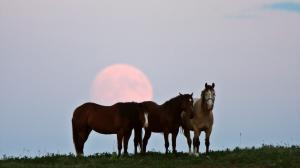
Ancient cultures gave names to the Full Moon. These names are still in use today.