

When Do Clocks Change in Europe?
Most European countries will set their clocks forward one hour at 01:00 UTC on March 29, 2026. The local time of the change depends on each time zone.
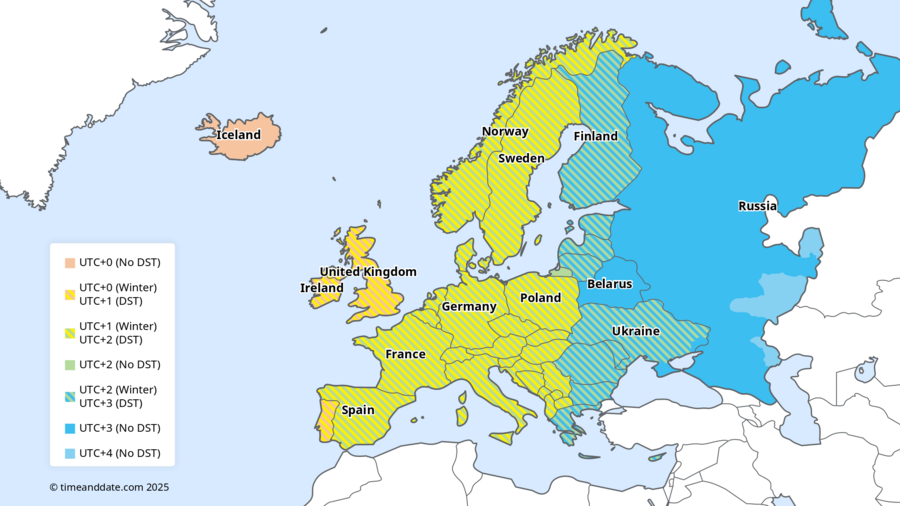
Since Europe spans several time zones, the switch from standard time (also known as winter time or normal time) to summer time occurs at different local times—see table at the bottom of the page for more details.
Clocks will go back to standard time on Sunday, October 25, 2026.
Check your local time for the Europe DST start 2026
EU Effort to End DST Deadlocked Since 2019
On March 26, 2019, the European Parliament voted in favor of the EU Committee draft directive to stop the one-hour clock change in the European Union by 2021.
The proposal later stalled in the Council of the European Union amid practical concerns, including challenges in coordination between Member States and decisions over which permanent time to adopt. In the years that followed, shifting political priorities—including the COVID-19 pandemic and the war in Ukraine — also meant the issue did not move forward.
For now, the twice-yearly clock changes remain in place, despite strong opposition expressed in the 2018 public consultation.
Europe’s time zones and DST scheduleIn October 2025, Spanish Prime Minister Pedro Sánchez said the current system hardly helps to save energy and has a negative impact on people’s health and lives.
“In all the surveys in which Spaniards and Europeans are asked, the majority are against changing the time,” Sánchez said, adding that he would push again to end clock changes in the European Union in 2026. So far, however, there has been no update on this initiative, and the EU has not taken a new decision on the matter.
This means the future of Daylight Saving Time in the EU is still uncertain, and the current system—changing clocks on the last Sunday in March and October—remains in place, for now.

Shorter than in the US and Canada
In the US and Canada, DST begins a few weeks earlier, on March 8, 2026.
DST in Europe is 21 or 28 days shorter than in the US and Canada, depending on how the Sundays fall in a given calendar year.

Daylight Saving Time in Europe
European countries coordinate their time changes. Under current EU law, DST starts on the last Sunday of March and ends on the last Sunday of October.
Countries that follow DST include:
Countries that do not have DST include Russia, Iceland, and Belarus.
Frequently Asked DST Questions
What is DST?
Daylight Saving Time (DST) is the practice of setting the clocks forward during part of the year to make better use of natural daylight. Changing the clocks does not create extra daylight, but it shifts civil time in relation to solar time. In other words, sunrise and sunset happen an hour later, on the clock, when DST is in effect.
Is Summer Time the same as DST?
Saying “summer time” instead of Daylight Saving Time (DST) is common in many countries, like the United Kingdom. The term winter time is sometimes used instead of standard time, which is the official name for the period without DST.
Is DST bad for your health?
Daylight Saving Time (DST) can mess with our body clock and can trigger underlying health issues. This time change can cause disruptions to our body clock, otherwise known as the circadian rhythm.