

If you don't have a zoom lens, try to focus on details around the eclipse.
©iStockphoto.com/bruev
Plan Your Pictures
Whether you have a smartphone or a more complex camera, planning is the key to a successful shot.
- Find the next solar eclipse. If you use a compass to angle your camera, make sure to take into account magnetic declination.
- Scout your location a few days ahead. Meet up early to avoid crowds and position yourself.
- Check the weather! Dense clouds can cover a solar eclipse, but scattered clouds can add interest to your image.
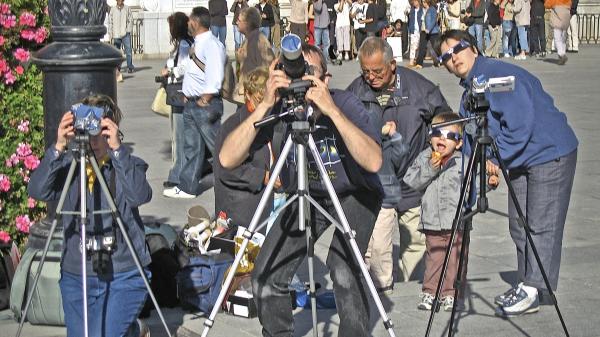
Phone camera opportunity: People watching the 2005 annular solar eclipse in Spain.
©iStockphoto.com/ONA_PLANAS
Can I Use My Phone Camera?
You cannot expect to take spectacular pictures of a solar eclipse using only your cell phone because smartphones and small compact cameras have a wide and small lens and a small sensor.
But, there are ways to capture the eclipse by playing to the strengths of your mobile phone.
- Find interesting scenery. Solar eclipses change both the light and shapes of the shadows. Compose your image by including trees, buildings, and reflections.
- Turn around. Sometimes the best picture is behind you.
- Project the Sun. Make a pinhole projector, and take pictures of the projection.
- Turn off your flash. Flash will disturb the natural light.
- Not happy with the result? Play around, and try again.
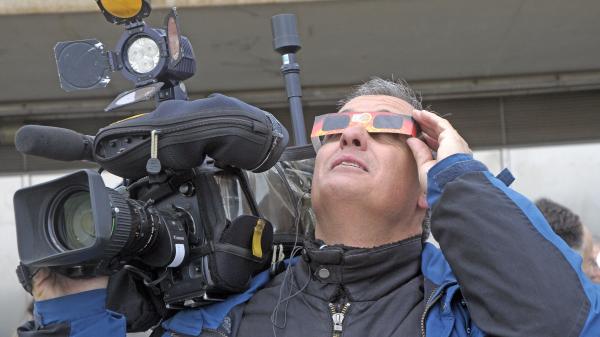
For detailed pictures of a solar eclipse you need more than a cell phone camera. Cameraman watching the 2015 partial solar eclipse in Spain.
©iStockphoto.com/AlbertoRoura
DSLR Cameras and Extra Equipment
A good digital single-lens reflex (DSLR) camera gives more control over the image components, but it also requires more equipment and skill.
- Eclipse filter. A special filter made for solar viewing must be used when photographing the Sun. Not using a filter can damage your camera.
- Focus carefully. Focus on the Sun’s edge, and readjust your focus during the eclipse. Practice on the Moon or a bright star the night before.
- Big lens. Use a focal length of at least 400mm or more.
- Stabilize. Put your camera on a tripod or anywhere stable like a fence or the ground. Use your timer or a shutter with a cord to minimize movement in the camera.
- Protect your eyes. Use the preview screen to view your composition.
- Give your camera breaks. The internal components can overheat and get damaged.
- Switch to manual. Manual gives more control of exposure. Bracket your exposures by shooting at various shutter speeds.
- High resolution. To capture as much information and detail as you can, set your camera to the highest resolution (jpeg) or take uncompressed images (tiff or raw).
- Keep shooting. Play around with the shutter speed for different exposures.
- Edit your images. You can crop, add contrast, tweak colors, layer, and so much more, by processing your images in Photoshop, Lightroom, or even free photo processing software online.