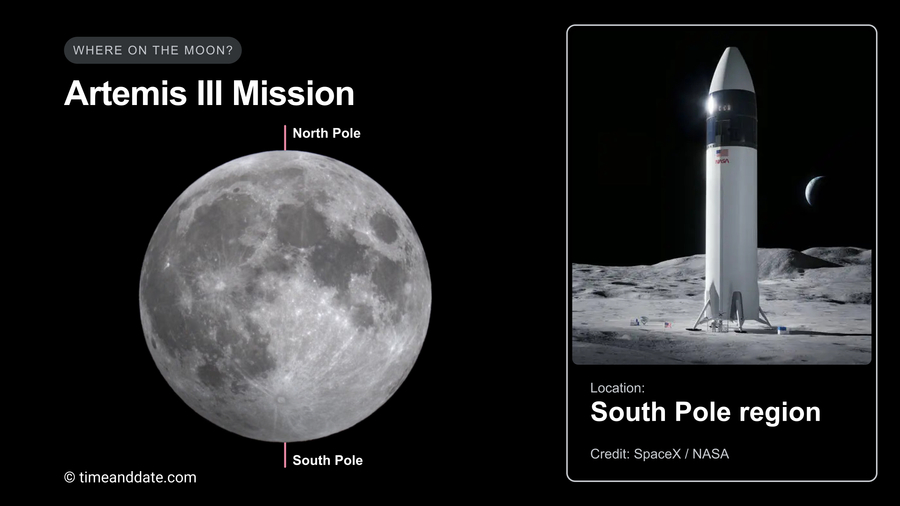
From the Equator to the South Pole
When humans return to the surface of the Moon in 2027, they will be exploring a region very different from the one Apollo astronauts visited between 1969 and 1972.
The Apollo missions 11, 12, 14, 15, 16, and 17 landed near the Moon’s equator. (Apollo 13 didn’t land on the Moon at all—“Houston, we've had a problem,” as astronaut Jim Lovell famously said when the spacecraft was about halfway to the Moon.)
For Artemis III, however, NASA has identified nine possible landing sites near the Moon’s South Pole.
The Moon: Our satelliteLight and Darkness
Why is the South Pole so different? A big reason is sunlight. Places near the Moon’s equator spend around two weeks in continuous sunlight, followed by roughly two weeks in continuous darkness. We can see this for ourselves as we watch the Moon wax and wane in our sky over the course of a month.
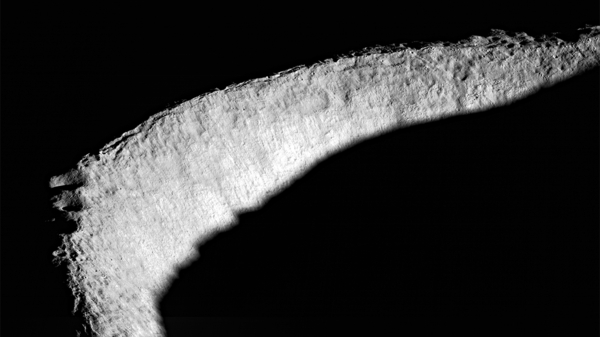
But around the Moon’s poles, the Sun never really rises or sets—instead, it skims along the horizon. In particular, the South Pole region has a number of craters where the peaks of the crater rims experience almost permanent, year-round sunlight. On the other hand, the insides of these craters lie in permanent, never-ending darkness.
When it comes to exploring the Moon, near-permanent sunlight is good for generating solar power. Meanwhile, the dark, cold areas in permanent shadow are good for finding frozen water and other icy compounds that scientists want to learn more about.
How to Find the South Pole
Roughly speaking, the South Pole is at the bottom of the Moon when viewed from Earth’s Northern Hemisphere, and at the top when seen from the Southern Hemisphere.
But that’s a bit of an oversimplification. Instead, it’s better to say the orientation of the Moon gradually changes as we move from the Northern Hemisphere to the Southern Hemisphere (or the other way round). One more thing: Even if we stay in one place, the Moon appears to rotate as it moves across our sky from east to west.
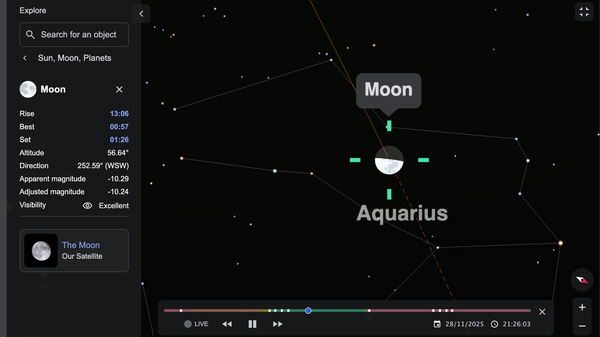
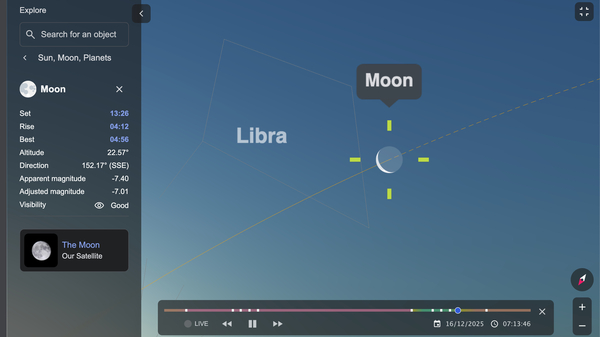
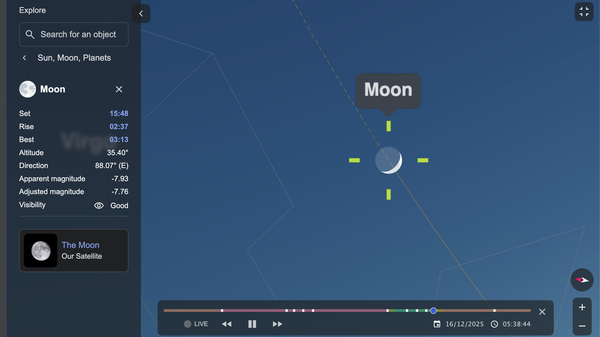
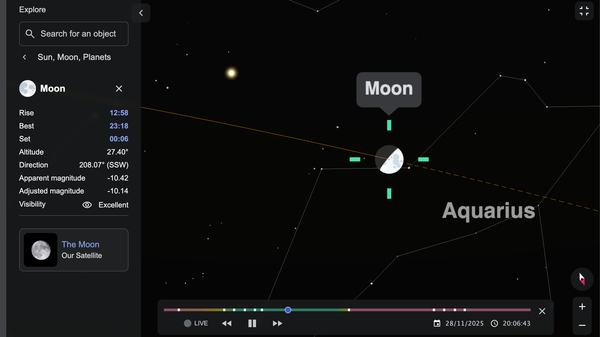
If this all sounds a bit complicated, below are some examples from our Night Sky Map.
Remember that the Moon’s poles are almost permanently illuminated. When we’re looking up at a Crescent Moon, the poles are approximately indicated by the sharp tips of the bright crescent; when we’re gazing at a Half Moon, the poles lie more or less at the two “corners” of the silvery semicircle.
How About at the Equator?
When viewed from places close to Earth’s equator, the Moon appears to “lie on its side.” As the Moon rises, the South Pole lies on the right-hand side of the Moon as we look toward the horizon. As the Moon sets, the South Pole is on the left-hand side of the Moon.