

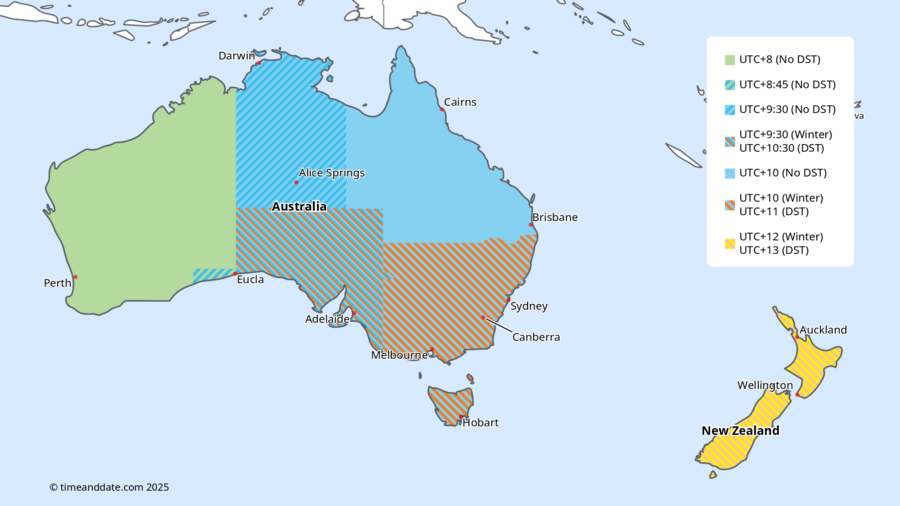
Clocks in areas of Australia that observe DST will be set back 1 hour to standard time from 03:00 (3 am) to 02:00 (2 am), local time on April 5, 2026.
Australia clock change in detail
Australia’s Clock Changes
Clocks will be turned back one hour in the following states and territories:
Norfolk Island also observes DST and sets clocks back 1 hour on the same date.
On Lord Howe Island, located in a rare half-hour time zone, clocks are set back 30 minutes instead of one hour on the same date (the island shifts from 02:00 to 01:30). Lord Howe Island is an external territory of New South Wales.

No DST in Parts of Australia
Time zones in Australia are often considered confusing.
Johan Locke, an AI and assistive technology expert timeanddate.com interviewed previously, thinks the time changes have created a fragmented system that leaves residents in a perpetual state of confusion. He says: “At any given moment in Australia, someone, somewhere, is confused about what time it actually is. This is because only some states observe DST while others refuse to participate in the madness.”
Northern and western parts of Australia do not use DST, so the clocks will not change in Queensland, the Northern Territory, and Western Australia.
The same applies to the Australian dependencies Christmas Island and Cocos (Keeling) Island.
DST has left Australia “with a patchwork of time zones more confusing than an IKEA instruction manual.”
Johan Locke, AI and assistive technology expert
Dealing with the Chaos of Daylight Saving TimeNew Zealand Clock Change
All of New Zealand observes DST, including Auckland, Christchurch, and Wellington.
Clocks will be set back 1 hour from 03:00 (3:00 am) to 02:00 (2:00 am), local time, on April 5, 2026.
New Zealand clock change in detailThe Chatham Islands, in New Zealand’s second time zone, are 45 minutes ahead of the two main islands, so clocks there are turned from 03:45 (3:45 am) to 02:45 (2:45 am) local time.
The New Zealand-dependent territory of Tokelau does not use DST.

No DST in Samoa or American Samoa
Samoa continues to observe year-round standard time after it scrapped DST in 2021. Neighboring American Samoa does not have clock changes either.
Upcoming DST changes worldwideWhen Does DST Start Again?
Daylight Saving Time in Australia runs from the first Sunday in October to the first Sunday in April each year. DST will start again on October 4, 2026.
In New Zealand, DST starts again on September 27, 2026. Kiwis observe DST from the last Sunday in September to the first Sunday in April.
DST starts in Europe in 2026 DST starts in the USA in 2026Frequently Asked DST Questions
What is DST?
Daylight Saving Time (DST) is the practice of setting the clocks forward during part of the year to make better use of natural daylight. Changing the clocks does not create extra daylight, but it shifts civil time in relation to solar time. In other words, sunrise and sunset happen an hour later, on the clock, when DST is in effect.
Is Summer Time the same as DST?
Saying “summer time” instead of Daylight Saving Time (DST) is common in many countries, like the United Kingdom. The term winter time is sometimes used instead of standard time, which is the official name for the period without DST.
Is DST bad for your health?
Daylight Saving Time (DST) can mess with our body clock and can trigger underlying health issues. This time change can cause disruptions to our body clock, otherwise known as the circadian rhythm.