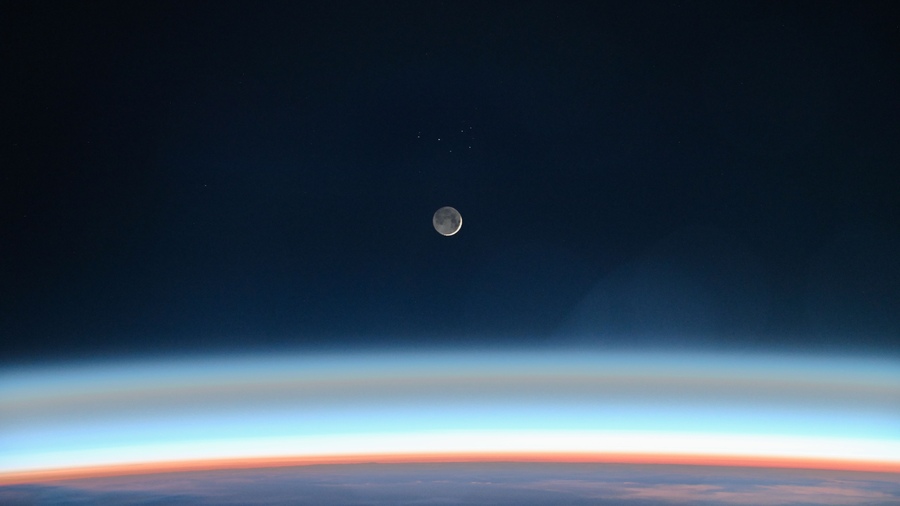
An Exceptionally Large Earth-Moon Distance
The Moon’s orbit is not a perfect circle with the Earth precisely in the middle. Instead, it’s a slightly squashed circle, with the Earth slightly off-center.
This means the distance from the Earth to the Moon is continuously changing. When the Moon is particularly close, it is often called a Supermoon; when it is far away, it is known as a Micromoon.
The most extreme Earth-Moon distances—the very biggest or very smallest separations of the two bodies—happen around New Moon or Full Moon.
An exceptionally big distance is coming up this month. A few hours before New Moon on November 20, 2025, the Moon will be at its farthest distance from Earth for the next 18 years.

No Two Orbits Are the Same
The farthest point in the Moon’s monthly orbit around Earth is called apogee; the nearest point is called perigee. (If you need help remembering which way round these words go, we like that apo and far both have three letters, while peri and near both have four letters.)
Why do the most extreme apogees and perigees coincide with New Moon or Full Moon? Because that’s when the Earth, Moon, and Sun are aligned, and the Sun’s gravity gives the Moon’s orbit an extra stretch or squeeze.
And why are some extremes greater than others? It’s a combination of factors, including how closely apogee or perigee coincides with a New or Full Moon. The Earth-Sun distance—which, like the Earth-Moon distance, is continuously changing—also has an effect.
The Farthest Moons This Half-Century
The table below shows the four biggest Earth-Moon separations during the first half of the 21st century (from 2001 to 2050).
Distances are measured from the center of the Earth to the center of the Moon, and dates are given in UTC. All four dates coincide with a New Moon. (As a general rule, exceptionally large Earth-Moon distances coincide with a New Moon, while exceptionally small distances correspond to a Full Moon.)
The next time the Moon is as remote as it is in November 2025 will be 18 years from now, in December 2043.
The Most Remote Point of All
The Moon reaches its farthest distance on November 20, 2025, around 02:46 UTC. This is about four hours before the moment of New Moon at 06:47 UTC.
To recap, distances are measured from the Earth’s center to the Moon’s center. So a fun question is: Which point on Earth’s surface will be farthest of all from the Moon?
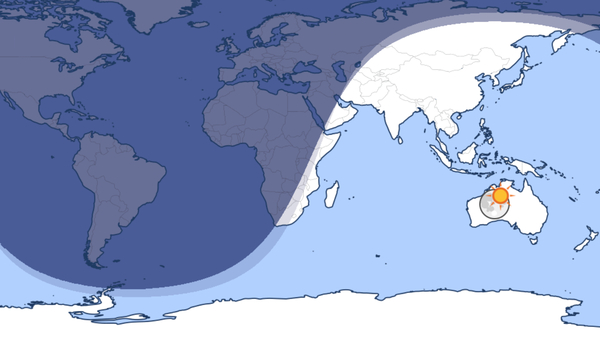
Our Moon Light World Map tool shows us that, at 02:46 UTC on November 20, the Moon will be directly over Western Australia. To put it another way, people in Western Australia will be the closest to the Moon.
Given that the Earth has a radius of approximately 6371 km (3959 miles), while the Moon has a radius of about 1737 km (1079 miles), the distance from Western Australia to the surface of the Moon will be more like 398,600 km (247,700 miles).
The point opposite Western Australia on the globe is in the North Atlantic Ocean, about 1500 km (930 miles) south-east of Bermuda. This will be the farthest point of all from the Moon: The distance from Bermuda to the Moon’s surface will be 411,300 km (255,600 miles) or so.