

When to See the Full Moon in November
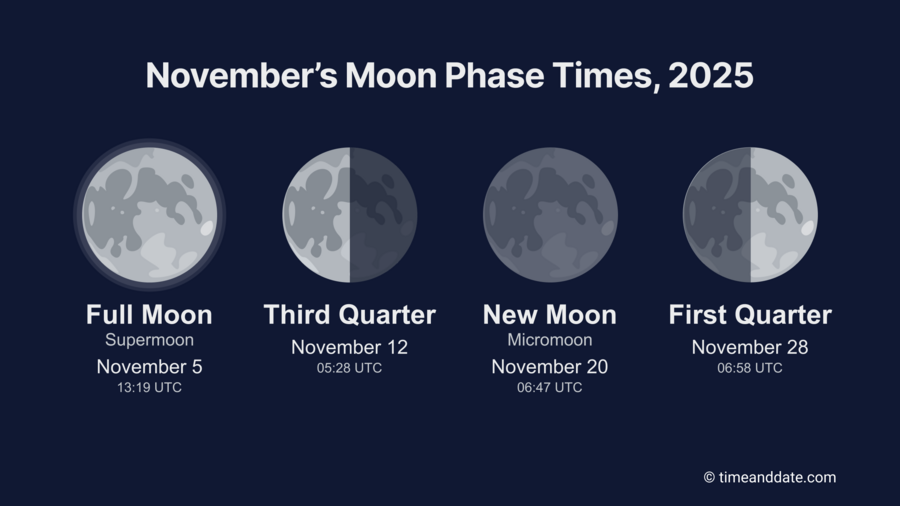
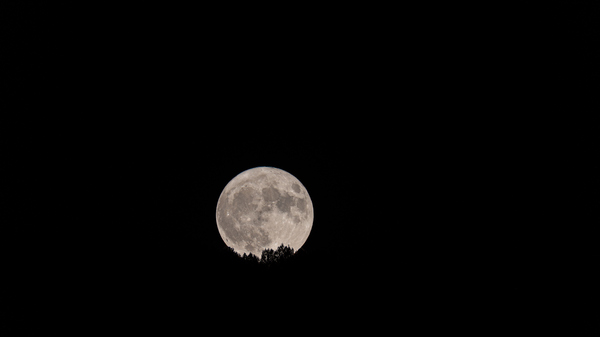
November’s Full Moon is at its most illuminated at 13:19 UTC on November 5, 2025.
The Moon always appears full in the days before and after peak illumination. Full Moon is the only phase where the Moon is up all night, with moonrise and moonset occurring around sunset and sunrise.
See where the Moon is right nowMoon Phase Times November 2025
Moon phases are divided into primary and intermediate: Primary Moon phases happen at a specific moment in time, while the intermediate Moon phases occupy the times in between.

An Exceptionally Large Earth-Moon Distance
A few hours before New Moon on November 20, 2025, the Moon will be at its farthest distance from Earth for the next 18 years.
Read more about the most remote Moon until 2043The Long History of Full Moon Names
These days, not many of us pay close attention to Moon phases. But until very recently in human history, Full Moons were an important part of how we kept track of time throughout the year.
Different cultures gave different names to each of the Full Moons to mark the changing seasons. In English-speaking countries today, each month’s Full Moon has a variety of names that draw on the traditions of Native Americans, the Celts, the Anglo-Saxons, the medieval English, and neo-paganism.
Since Full Moon names are based on ancient customs and folklore, there are no “official rules”—and it can be a fascinating challenge to unravel the precise meaning and intention behind each name.
This November: The Hunter’s Moon
We recently had an enjoyable discussion with our old friends Deborah Byrd and Marcy Curran at EarthSky. On our pages here at timeanddate, we’ve usually listed November’s Full Moon as the Beaver Moon, while October’s Full Moon is either the Hunter’s Moon or, if it is the closest Full Moon to the September equinox, the Harvest Moon.
Deborah and Marcy, who both have many decades of experience in this area, had a subtly different take on things: The Hunter’s Moon always follows the Harvest Moon. Since this year’s Harvest Moon fell in October, the November 2025 Full Moon becomes the Hunter’s Moon.
We delved into the literature and found some good evidence to support this; we’re in the process of updating our own listings as a result.
Remember, Full Moons have multiple names. So this month’s Full Moon can still be called the Beaver Moon—or the Frost Moon, or the Freezing Moon—but, this year, it is also the Hunter’s Moon.

It’s Also a Supermoon
Another area where there are no “official rules” is the question: What is a Supermoon?
The Moon’s distance from Earth varies over the course of a month. At its closest, it’s around 357,000 km (222,000 miles); at its farthest, it’s about 406,000 km (252,000 miles). These most extreme distances coincide with Full Moons and New Moons, and are known as Supermoons (when the Moon is very close) and Micromoons (when it’s very far away).
But how close does the Moon have to be to qualify as a Supermoon? On this, there is no general agreement. Some sources set the bar fairly low, which produces three or even four Super Full Moons per year.
At timeanddate, we set the bar a bit higher. Our rule—which generally produces only two Super Full Moons per year—is that the Moon has to be within 360,000 km (which comes out to 223,694 miles).
At the moment of Full Moon in November, the Earth-Moon distance (measured from the center of the Earth to the center of the Moon) will be 356,978 km (221,816 miles). So even under our relatively tough criteria, November’s Full Moon will be a Super Hunter’s Moon.
The Moon & Planets in November
Every month, the Moon completes one circuit around the sky, passing through the same 12 or so constellations that the Sun does over the course of a year.
Along the way, the Moon sweeps by each of the planets. This month’s notable close approaches are as follows:
- November 2, Moon-Saturn: See it on our Night Sky Map around midnight in New York
- November 10, Moon-Jupiter: Have a look at the view from London about an hour before sunrise
- November 29, Moon-Saturn: The Moon catches up with Saturn again—seen here from Sydney at 23:00 (11 pm)
The above close approaches are visible from more or less any part of the world—we’ve included the examples from our Night Sky Map to give you a taste of the view from different cities.

Frequently Asked Moon Questions
When is the next Full Moon?
This month’s Full Moon is on November 5 at 13:19 UTC. The next Full Moon in 2025 is on December 4 at 23:14 UTC, and is again a Supermoon.
Does the Full Moon affect moods?
Overall, there has been little hard evidence to prove that the Moon has a measurable effect on human physiology and behavior.
When was the last Blue Moon?
The last Blue Moon was on August 19, 2024, and the next Blue Moon is on May 31, 2026.