
A Cosmic Companion for a Red Giant
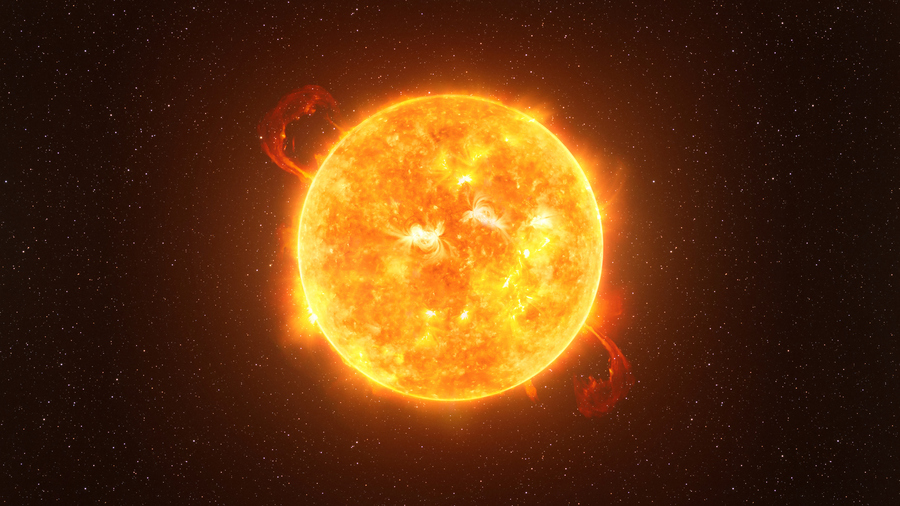
For nearly a century, scientists thought the red supergiant star Betelgeuse might be orbited by a smaller gas body. Their hypothesis was finally confirmed in July 2025, when NASA researchers announced they were able to pick out this companion star for the first time.
A team from the Ames Research Center combed through data from the Gemini North telescope and scanned images from a specially-designed camera that was able to cut through the bright glare emanating from Betelgeuse. With clearer and sharper pictures of the area, the team was able to identify a previously-unknown gas body thought to be 1.7 times the mass of our Sun.
The discovered star, located in the constellation of Orion, was given a name honoring the Arabic roots of “Betelgeuse” (pronounced beh·tuhl·juhz), which means “the hand of al-Jawza” (a female figure in Arabian legend). The researchers dubbed this orbiting companion “Siwarha,” or “her bracelet.”
Ticking Timebomb
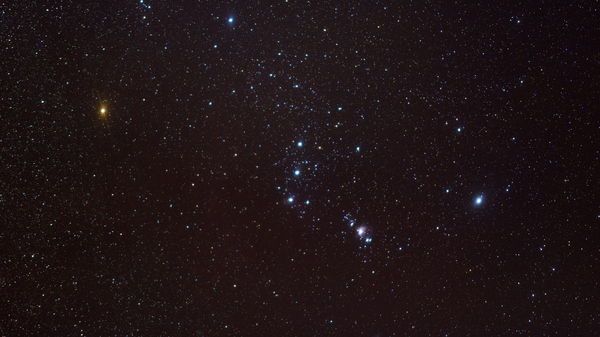
Some astronomers thought the light pattern emanating from Betelgeuse, positioned some 700 light years from Earth, indicated it was likely to explode into a supernova relatively soon (sometime in the next 100,000 years).
Eruption of T-Coronae Borealis
But with the discovery of Siwarha, scientists now think that this companion star may have affected the dimming and brightening of the red supergiant, creating a degree of uncertainty about how soon it might explode.
No matter when Betelgeuse, which is about 1000 times larger than our Sun, erupts into a supernova, it will create a spectacular display that will be visible to the naked eye on Earth.
But even if there are no stars exploding near you at the moment, the skies are still full of activity that you can see with little or no equipment.
Cutting Through the Glare
Betelgeuse created a real mystery for astronomers. For years, scientists studying the star’s light curve (its pattern of waxing and waning) wondered if their data was being affected by a companion star.
The technological breakthrough they needed to answer their questions came with the development of the ’Alopeke Speckle Instrument. This highly advanced camera takes thousands of short exposures that are free from atmospheric distortion, giving astronomers a dramatically clearer picture of objects in space.
With a relatively sharp picture of this companion star in hand, the NASA team was able to finally establish the existence of Siwarha, and publish their findings in a paper in the July 2025 issue of The Astrophysical Journal Letters titled “The Probable Direct-imaging Detection of the Stellar Companion to Betelgeuse.”