


When to See the Full Moon in January
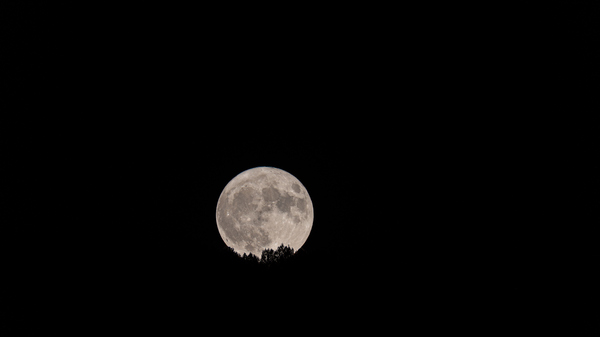
January’s Full Moon is at its most illuminated at 10:02 UTC on January 3, 2026.
The Moon always appears full in the days before and after peak illumination. Full Moon is the only phase where the Moon is up all night, with moonrise and moonset occurring around sunset and sunrise.
See where the Moon is right nowMoon Phase Times January 2026
Moon phases are divided into primary and intermediate: Primary Moon phases happen at a specific moment in time, while the intermediate Moon phases occupy the times in between.

What Do We Call This Full Moon?
January’s Full Moon is the Wolf Moon. The name is thought to have a Celtic and Old English origin, honoring an animal that tends to be active during the early part of the year. Other Celtic names for the Full Moon include the Stay Home Moon and the Quiet Moon.
In Anglo-Saxon culture, this month’s Full Moon was also called the Moon after Yule. Pre-Christian Yule (or Juul) is the ancient winter solstice festival usually celebrated around December 21.
In some Native American cultures, it is known as the Severe Moon or the Center Moon.

Is It a Supermoon?
A Supermoon is a Full Moon or New Moon that coincides with the Moon being near its closest point to Earth. How close is close? On this, there is no official agreement!
At timeanddate.com, we define a Supermoon as a Full or New Moon where the Earth-Moon distance, measured from the center of the Earth to the center of the Moon, is less than 360,000 km (223,694 miles).
At the moment of Full Moon on January 3, the Earth-Moon distance is 362,312 km (225,130 miles). So it’s not a Supermoon by our definition. However, other sources have different approaches, and some are classifying this month’s Full Moon as a Supermoon.
Why Are Some Moons “Super”?
The Moon’s distance from Earth varies in a cycle that lasts 27.55 days on average. Astronomers call this an anomalistic month.
At its closest point to Earth—which astronomers call perigee—the Earth-Moon distance is somewhere between roughly 356,500 km and 370,000 km.
Why is the closest distance not the same every time? Because “super” close distances only happen when perigee falls close to Full Moon or New Moon. On these occasions, the Earth and Moon are in alignment with the Sun, and the Sun’s gravity squeezes the Moon’s orbit around Earth.
How Did We Choose 360,000?
We wanted a Supermoon definition that was simple and straightforward, so we based it on a single variable: The Earth-Moon distance at the moment of Full Moon or New Moon must be less than 360,000 km.
Roughly speaking, this occurs when perigee falls within one day of Full or New Moon. It is also roughly within one percent of the closest possible Earth-Moon distance—which, in this century, is 356,425 km (on December 6, 2052).
In addition, of course, 360,000 km is a nice round number, and there are good precedents for this. For example, the Kármán line—generally accepted as the point where “outer space” begins—is set at 100 km above mean sea level.
The Moon & Planets in January
Every month, the Moon completes one circuit around the sky, passing through the same 12 or so constellations that the Sun does over the course of a year.
Along the way, the Moon sweeps by each of the planets. This month’s notable close approaches are as follows.
- January 3, Moon-Jupiter: See it on our Night Sky Map for New York.
- January 23, Moon-Saturn-Neptune: Have a look at the view from London around 19:30 (7:30 pm). You’ll need a pair of binoculars or a telescope to pick out Neptune, the farthest planet from the Sun, hiding between the Crescent Moon and Saturn.
- January 31, Moon-Jupiter: The Moon catches up with Jupiter once again—seen here from Sydney at 21:30 (9:30 pm).
The above close approaches are visible from more or less any part of the world—we’ve included the examples from our Night Sky Map to give you a taste of the view from different cities.

Frequently Asked Moon Questions
When is the next Full Moon?
This month’s Full Moon is on January 3 at 10:02 UTC. It is the first Full Moon of 2026. The next Full Moon will be on February 1.
Does the Full Moon affect moods?
Overall, there has been little hard evidence to prove that the Moon has a measurable effect on human physiology and behavior.
When was the last Blue Moon?
The last Blue Moon was on August 19, 2024, and the next Blue Moon is on May 31, 2026.