


What’s Up in the Sky in January
January 2026 delivers dark winter skies in the Northern Hemisphere and warm summer evenings in the Southern Hemisphere. It’s usually a great month for stargazing wherever you are, perhaps especially in the Northern Hemisphere.
The Quadrantid meteor shower kicks off the year, alongside the glowing Wolf Moon. Jupiter shines bright near its opposition, and you can also catch a neat Moon–Neptune–Saturn close approach.
From meteors to planets, January sets the tone for a sky-watching year full of highlights.
*Naked-eye events. Night Sky Map links are from New York City, USA.
January’s Wolf Moon
This year, January’s Full Moon is at its most illuminated at 10:02 UTC on January 3, 2026. It follows last month’s Super Cold Moon.
Do we also get a Supermoon in January? There is no official definition of when the Moon is close enough to be a Supermoon, so different sources have different definitions . But according to our definition, the January Wolf Moon is not a Supermoon.
The Full Moon in January is called the Wolf Moon, named after active wolves during the early parts of the year. Some believe wolves howl more in January to find pack members, mark territory, and coordinate hunts.
The name is thought to have a Celtic and Old English origin, brought over to North America by European settlers. Other Celtic names for the Full Moon include Stay Home Moon and Quiet Moon. It’s also known under other names.
Don’t forget to look up on January 3 to catch the Wolf Moon in the sky. You can also say hi to Jupiter, appearing close by.
Your Moon Guide for January 2026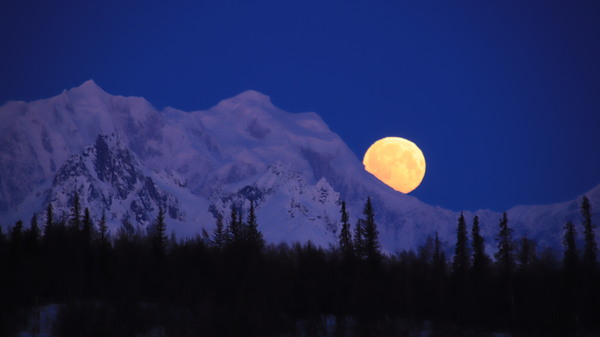
Quadrantid Meteor Shower in January
The Quadrantid meteor shower is the first major meteor shower of the year. There is a possibility of sighting around 80 meteors per hour at its peak, which is on January 3 or 4.
Unlike other meteor showers that tend to stay at their peak for about two days, the peak period of the Quadrantids only lasts a few hours. This is because the stream of debris from asteroid 2003 EH1 is quite narrow, and Earth passes through it at a specific angle. The asteroid takes about 5.5 years to orbit the Sun.
Since the Full Moon is at its most illuminated the same night, the number of visual shower meteors will be reduced a lot. Luckily, the Quadrantids are also known for their bright fireball meteors. If any appear, these will be easier to see during the Full Moon.
The best places to view it are in the Northern Hemisphere during the night and early morning hours.
The shower owes its name to the now-defunct constellation Quadrans Muralis.
The constellation was left off a list of constellations drawn up by the International Astronomical Union in 1922. However, since the shower had already been named after Quadrans Muralis, its name was not changed. The Quadrantids are also sometimes called Bootids after the modern constellation, Boötes.
Graham Jones, Astrophysicist
timeanddate.com
Jupiter at Opposition
On January 10, Jupiter is at opposition. What does this mean?
A planet is at opposition when it forms a straight line with the Sun and Earth in space, with Earth in the middle. When this happens, the planet sits directly opposite the Sun in our sky, and rises as the Sun sets, staying visible all night. It is also roughly at its closest to Earth, making it appear brighter and easier to spot.

Only the superior planets—Neptune, Uranus, Saturn, Jupiter, and Mars—can line up this way, since they orbit farther from the Sun than we do. On the other hand, we have the inferior planets, Mercury and Venus, which never reach opposition because their orbits sit inside Earth’s.
This is a great chance to catch Jupiter at its best—it won’t be back in opposition again until February 2027. Jupiter also makes a striking pair with the Moon this month, swinging close by in the sky both at the beginning and end of the month.
Moon-Neptune-Saturn Line Up
The Moon, Neptune, and Saturn will appear close to each other in the evening sky on January 23, 2026.
Saturn is one of the easiest objects to spot in the night sky with the naked eye—no extra equipment is necessary. (Obviously, the same goes for the Moon.)
For Neptune, binoculars or a telescope are needed. But since it’s close to the Moon and Saturn this evening, it’s easier to locate in the sky. Neptune is the eighth planet from the Sun and the farthest known planet in the solar system. If you ask us, that makes it even more fun and impressive if you’re actually able to spot it this month!

Frequently Asked Questions
What is the Wolf Moon?
It‘s the January Full Moon, named after howling wolves in winter in the Northern Hemisphere.
How many meteors can I spot during the Quadrantids?
There is a possibility of sighting around 80 meteors per hour at its peak, which is on January 3-4. But the bright light from the Full Moon will reduce this number.
What is the difference between a conjunction and a close approach?
A close approach—also known as an appulse—is when celestial bodies appear close to each other in the sky. Objects appear close from our perspective, even though they are far away from each other.
Although the term conjunction is often used to refer to close groupings of celestial bodies, the technical definition refers to the exact moment two astronomical objects share the same right ascension (part of a coordinate system used by astronomers).