

What’s Up in the Sky in November?
*Naked-eye events. Night Sky Map links are from New York City, USA.

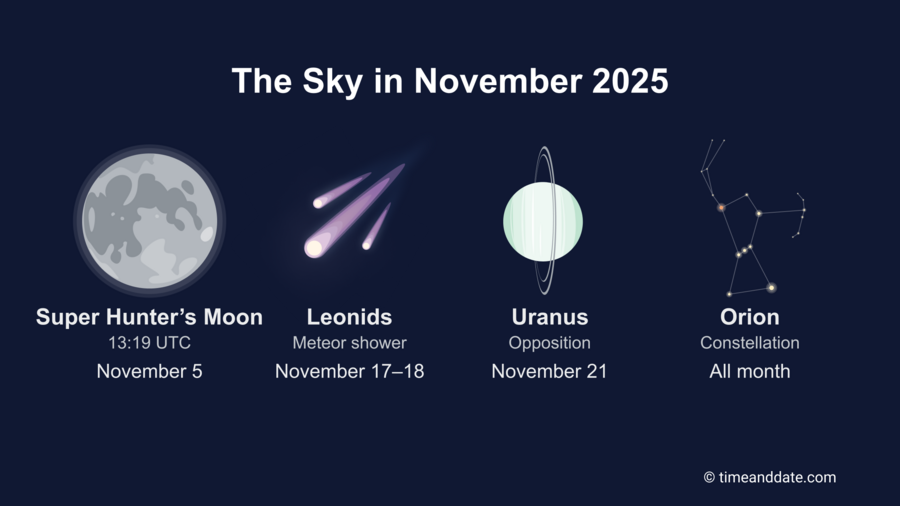
Super Hunter’s Moon
This year, November’s Full Moon is at its most illuminated on November 5, 2025, at 13:19 UTC. It’s following the Harvest Moon, and this time it’s also a Supermoon—a Full Moon occurring near the Moon’s closest approach to Earth.
We typically list November’s Full Moon as the Beaver Moon, but this year it also qualifies as the Hunter’s Moon because it follows October’s Harvest Moon.
Full Moons can have multiple names, so November’s Moon can still be called the Beaver Moon—or the Frost or Freezing Moon—while also being the Hunter’s Moon this year.
Don’t forget to look up on November 5 to catch the Super Hunter’s Moon lighting up the sky.
Two weeks later, around New Moon on November 20, the Moon will be at its farthest distance from Earth for the next 18 years.
Read more about the most remote Moon until 2043Leonid Meteor Shower
Meteors, or shooting stars, are bright streaks of light caused when space rocks burn up in Earth’s atmosphere. Meteor showers happen as Earth travels through debris left behind by a comet or asteroid.
The Leonid meteor shower is active in November, increasing your chances of spotting a shooting star. The shower gets its name from its radiant, the point in the sky where the meteors seem to emerge from, which lies in the constellation Leo.
The Leonids occur when the Earth passes through the debris left by Comet Tempel-Tuttle. The comet takes around 33 years to make one orbit around the Sun.
Tips for watching meteor showersUranus at Opposition
Celestial objects are at opposition when they lie directly opposite the Sun in our sky. Earth will move between the Sun and Uranus—the seventh planet from the Sun—on November 21, 2025. This alignment marks the peak of the most favorable period of the year for observing Uranus.
The best time to see “The Sideways Planet” is around mid-October to mid-December. Although it is possible to spot the planet with the naked eye under good conditions, it can be quite difficult.
Viewing conditions are best during the New Moon, when the skies are darkest. The good news is that this year, New Moon coincides with the date of opposition. Oppositions of Uranus happen every 370 days or so.
Our Night Sky Map shows the apparent magnitude of Uranus at opposition will be 5.60. The adjusted magnitude, which accounts for the effects of Earth’s atmosphere, is a bit worse.
What does this all mean? It means that Uranus will be on the very edge of naked-eye visibility. We’ll need a really dark sky, away from light pollution, and we’ll need to wait at least 20 minutes for our eyes to get adapted to the dark. The Pleiades star cluster and the bright star Aldebaran might be helpful pointers for finding the position of Uranus in the sky.
Graham Jones, Astrophysicist
timeanddate.com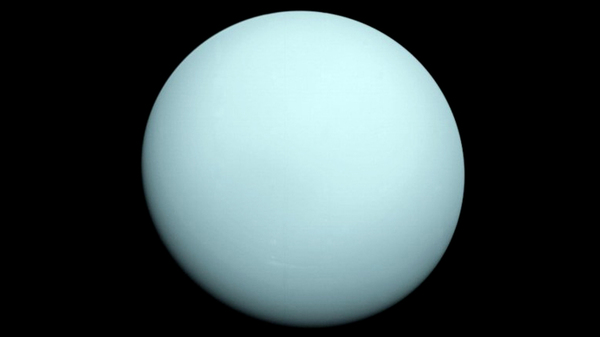
How to Find Orion This Winter
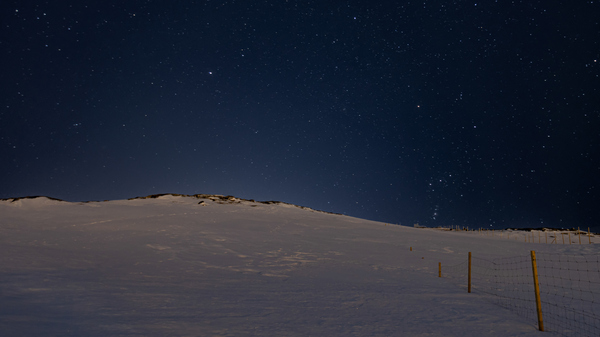
From November through March, the sky becomes an excellent stage for spotting the constellation Orion. This period places Orion on the same side of the Sun as Earth, allowing its stars to appear bold and clear from evening through the early hours of the morning. Wintertime in the Northern Hemisphere also provides longer periods of darkness for observation.

A reliable way to locate Orion is to use our interactive Night Sky Map. If you’re observing manually, look toward the Southern Horizon (or Northern Horizon if you’re in the Southern Hemisphere).
Orion’s famous belt, with its three bright stars forming a neat and easy-to-identify line, sits about halfway between the stars Betelgeuse and Rigel, which mark the shoulders and feet of the constellation. Rigel is the brightest star in the constellation, and Betelgeuse is a red supergiant with a noticeable red hue.
Orion’s belt is often helpful as a guide to the bright star Sirius. Many stories surround the hunter Orion, and in Greek mythology, he is known for pursuing the seven sisters in the Pleiades star cluster.

Frequently Asked Questions
What is a meteor shower?
Meteors, or shooting stars, are bright streaks of light caused when space rocks burn up in Earth’s atmosphere. Meteor showers happen as Earth travels through debris left behind by a comet or asteroid.
How many planets are there?
According to the latest definition, there are 8 planets in our solar system.
How long does it take to get to Uranus?
The only spacecraft to visit Uranus so far, Voyager 2, took about 8.5 years to make the journey after its launch in 1977, arriving in 1986.