

What’s Up in the Sky in December
The last month of 2025 brings many wonderful celestial events. In the Northern Hemisphere, nights are at their darkest, though daylight gradually increases after the December solstice. In the Southern Hemisphere, the solstice ushers in summer and long, bright evenings.
No matter where you are on Earth, December offers plenty to look forward to, including a major meteor shower, brilliant Mercury, and several planetary close encounters involving the Moon.
Dec 19: Comet 3I/ATLAS closest to Earth*Naked-eye events. Night Sky Map links are from New York City, USA.
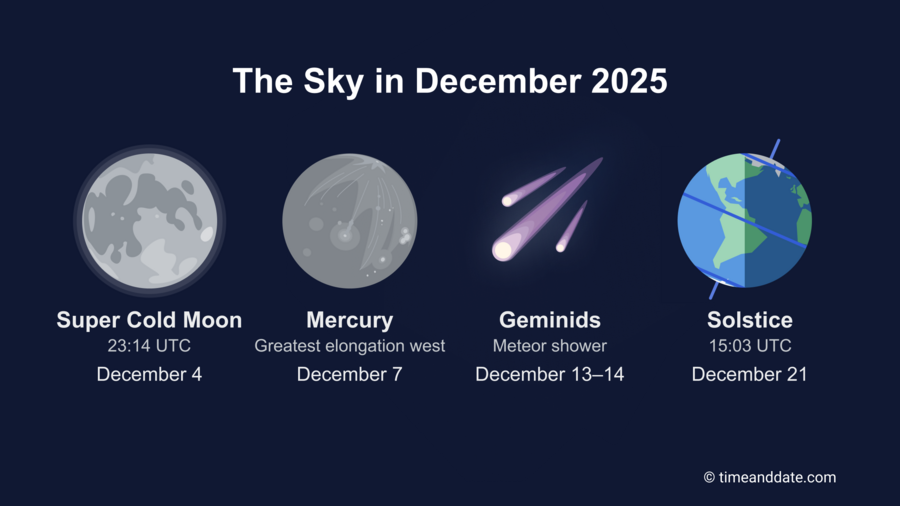
Super Cold Moon
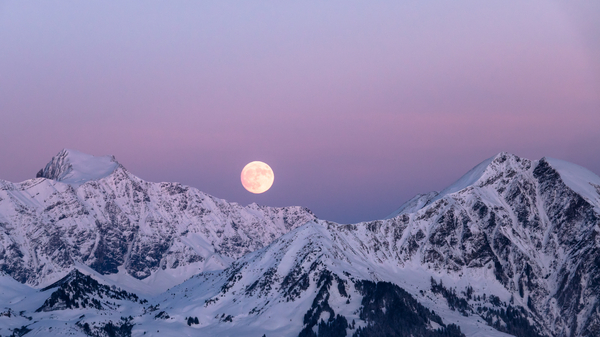
This year, December’s Full Moon is at its most illuminated at 23:14 UTC on December 4, 2025. It follows last month’s Super Hunter‘s Moon, and is again a Supermoon—a Full Moon occurring near the Moon’s closest approach to Earth.
The Full Moon in December is called the Cold Moon, named after the month where winter truly begins and it‘s getting colder in the Northern Hemisphere. Full Moons can have multiple names, and December’s Full Moon is also called Long Nights Moon, and the Moon before Yule.
Don’t forget to look up on December 4 to catch the Super Cold Moon in the sky.
Geminid Meteor Shower
Meteors, often known as shooting stars, are bright streaks of light produced when small pieces of space debris burn up in Earth’s atmosphere. Meteor showers occur as Earth moves through clouds of material left behind by a comet or asteroid.
The Geminid meteor shower is considered to be one of the most spectacular meteor showers of the year. There is a possibility of sighting around 120 meteors per hour at its peak, which is on December 13 or 14, depending on your time zone. The shower owes its name to the constellation Gemini because the meteors seem to emerge from this constellation in the sky.
Unlike most other meteor showers, the Geminids are not associated with a comet but with an asteroid: 3200 Phaethon. The asteroid takes about 1.4 years to orbit the Sun.
Because the Waning Crescent Moon doesn’t rise until a few hours after midnight on December 14, it won’t hinder meteor viewing too much. Although the Moon’s timing could be better.
For meteor showers, the Moon is at its most helpful when it’s not there! The Moon is the brightest object in the night sky—its glare lights up the darkness and hides fainter meteors.
Graham Jones, Astrophysicist
timeanddate.com
The December Solstice: The Longest and Shortest Day
December 21 is the December solstice, the longest and shortest day of the year. To be precise, the solstice happens at exactly 15:03 UTC on December 21.
According to one definition of the seasons, it marks the start of winter in the Northern Hemisphere and the start of summer in the Southern Hemisphere. This day holds astronomical, cultural, and religious importance.
Although winter is often associated with darkness and cold in the Northern Hemisphere, the December solstice marks the “turning of the Sun,” when daylight gradually begins to increase.
For hundreds of years, people have been lighting up the darkest time of the year around the December solstice in the Northern Hemisphere—including the ancient celebration of Yule, a term derived from the Old Norse jól, which referred to the pre-Christian winter solstice festival.
Today, many Christians around the world celebrate the birth of Jesus Christ on Christmas Day, observed on December 25.
Many believe the date was chosen to coincide with ancient pagan festivals that celebrated the end of winter’s darkest days and the return of the Sun, though, sadly, not the return of warmth. The Winter Solstice, falling just a few days before Christmas on December 21 or 22, is astronomically considered the first day of winter in the Northern Hemisphere.
Aparna Kher, Research Team Lead
timeanddate.com
Polar Night—When and Where?
December is the polar night season in the northernmost parts of our planet—like here in Stavanger, Norway, where timeanddate.com has its office.
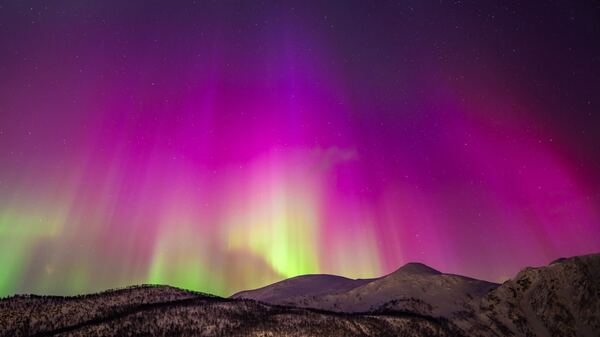
Even though the days are dark, there is also light: Christmas decorations brighten the streets, and the northern lights often glow in the sky, as shown in the photo below from our colleague Brendan, who lives and works in Harstad, northern Norway.
Arctic regions receive no direct sunlight around the December solstice, creating the phenomenon known as polar night within the Arctic Circle. This occurs in several populated parts of the Northern Hemisphere. After the September equinox, the Sun dips lower below the North Pole’s horizon, and the zone of polar night gradually expands southward until it encompasses nearly the entire Arctic Circle by the December solstice.
The only landmass far enough south in the Southern Hemisphere to have polar nights is Antarctica, around the June Solstice.
The opposite of polar night is Midnight Sun or polar day.

Frequently Asked Questions
What is the Cold Moon?
It‘s the December Full Moon, named after the cold temperatures of winter in the Northern Hemisphere.
How many meteors can I spot during the Geminids?
There is a possibility of sighting around 120 meteors per hour at its peak, which is on December 13 or 14, depending on your time zone.
What does the December solstice mark?
There are two solstices every year: one in December and one in June. The December solstice marks the shortest day north of the equator and the longest day in the south.